
Best Time for Tanzania Safari. You open a calendar, stare at twelve empty months, and wonder: when is the best time for a Tanzania safari? It’s one of the most common questions the team at Kisambi Tours hears from American travelers, and the honest answer is that there isn’t one perfect month for everyone. Tanzania has two completely different seasonal personalities, and the right time for your trip depends entirely on what you want to see and how much you’re willing to spend to see it.
Whether you’re chasing a Mara River crossing with thousands of wildebeest thundering into crocodile-infested water, or you want front-row seats to a lion pride working a calving herd in the southern Serengeti, the timing changes everything. This month-by-month guide explains the best time for a Tanzania safari for different priorities. By the end, you’ll know exactly which month matches your goals, which parks perform best in which seasons, and how to sequence a 7, 10-day itinerary that doesn’t waste a single day.
Tanzania’s two safari seasons explained
Tanzania runs on two broad rhythms: the dry season and the green season. Understanding the Tanzania safari seasons and the difference between them is the foundation of every good planning decision you’ll make, from which park to visit to how much you’ll pay per night.
The dry season (June, October): what it means on the ground
June through October is when Tanzania opens up. Grasses drop to knee height and below, water concentrates in rivers and permanent waterholes, and animals cluster in predictable locations. Game drives become dramatically more productive because there’s simply less cover for wildlife to disappear into. This window also aligns neatly with U.S. summer vacation calendars, which is one reason July and August see the highest park occupancy of the year.
The green season: short rains vs. long rains
The green season isn’t one uniform stretch of wet weather. The short rains run from November through December, arriving mostly as afternoon showers that leave mornings clear and roads largely accessible. The long rains, from March through May, are a different matter: heavier, more sustained, and capable of turning unpaved tracks in Tarangire and Ruaha into impassable mud within hours. January and February sit in a shoulder window between the two, offering calving season wildlife with moderate pricing.
How rain changes what you see and where you can go
Tall grass during the rains doesn’t just make game drives harder, it changes which predators you can reliably spot. Leopards and other cryptic cats become nearly invisible in high vegetation. Conversely, when dry-season grass drops below knee height, small cats that were invisible in February are observed far more frequently on game drives. In Ruaha and Tarangire specifically, the long rains can flood low-lying tracks entirely, forcing some camps to close and rerouting vehicles onto limited alternative roads that add significant time to every drive.
Best time for Tanzania safari: following the Great Migration month by month
The Great Migration is not a single event. It’s a year-round circular movement of wildebeest across the Serengeti ecosystem, and where you intercept it depends entirely on which chapter you want to witness. Many first-time travelers assume it happens in one place at one time. It doesn’t, and knowing the timeline changes how you plan your entire trip.
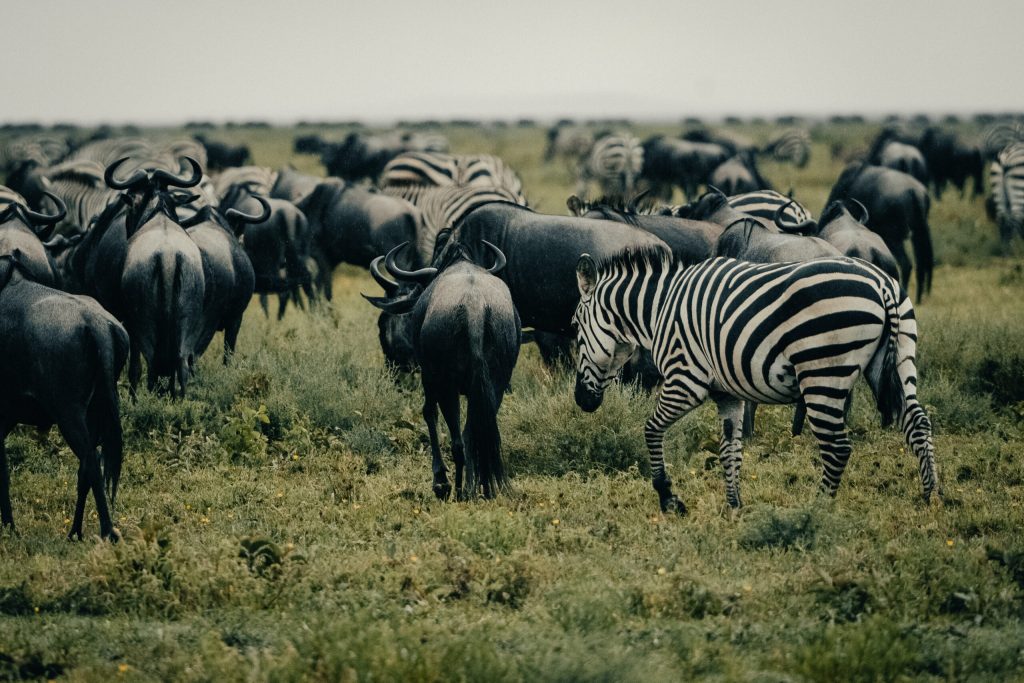 Calving season in the southern Serengeti (December, March)
From late December through March, the short-grass plains of Ndutu and the southern Serengeti transform into a nursery. The calving peak hits in February, when thousands of wildebeest calves are born daily. Lions, cheetahs, hyenas, and wild dogs converge on the same area, creating some of the most intense predator action of the entire year. There are no river crossings here, but the predator density and the sheer abundance of newborns make this one of the most photogenic periods on the entire Tanzania safari calendar.
Western Corridor crossings at the Grumeti River (May, June)
By May, the herds push westward and hit the Grumeti River, the first major obstacle of the northward journey. Crossings here are smaller than the famous Mara crossings but carry their own drama: crocodile-infested water, herds sometimes stalling on the bank for days before committing. June brings the peak of Grumeti action, before the migration turns north and begins its push toward the Mara River.
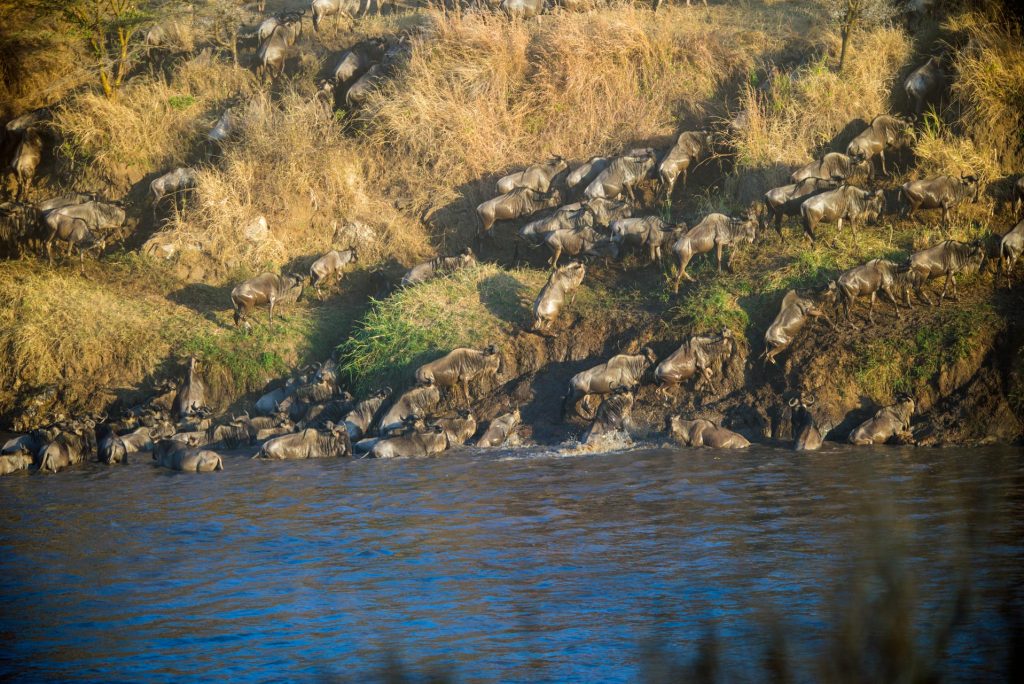 When to go for Mara River crossings: northern Serengeti (July, October)
This is the headline event most travelers picture when they think of the migration. Frontrunner herds reach the Kogatende area and the Mara River in July, with August delivering the most consistent and densely packed crossings of the year. Some herds move into Kenya’s Maasai Mara in September, but roughly half the migration remains on the Tanzanian side, meaning the crossings continue in Tanzania well into October, with peak activity typically concentrated in August and September. By late October, the herds reverse direction and begin the southbound return, crossing the Mara again before heading back toward the Ndutu Plains.
One critical planning note: exact crossing dates shift with rainfall. A dry year can push crossings as early as late June. A wet year can delay peak activity until mid-September. This is why real-time local intelligence from a team on the ground matters far more than any fixed calendar.
Which months each park peaks for game viewing
Tanzania’s parks each follow their own seasonal logic, and a well-sequenced multi-park itinerary captures the best of several ecosystems in one trip. Here’s how the major destinations break down.
Serengeti: different zones, different timing
The Serengeti is large enough that “best month” depends entirely on which section you visit. Southern Serengeti (Ndutu) peaks from January through February. The Western Corridor peaks from May through June. Northern Serengeti around Kogatende peaks from July through October. The central Seronera Valley offers year-round lion and leopard sightings, with the dry season delivering sharper views and fewer vehicles obscuring sightlines.
Ngorongoro Crater and the Ndutu Plains
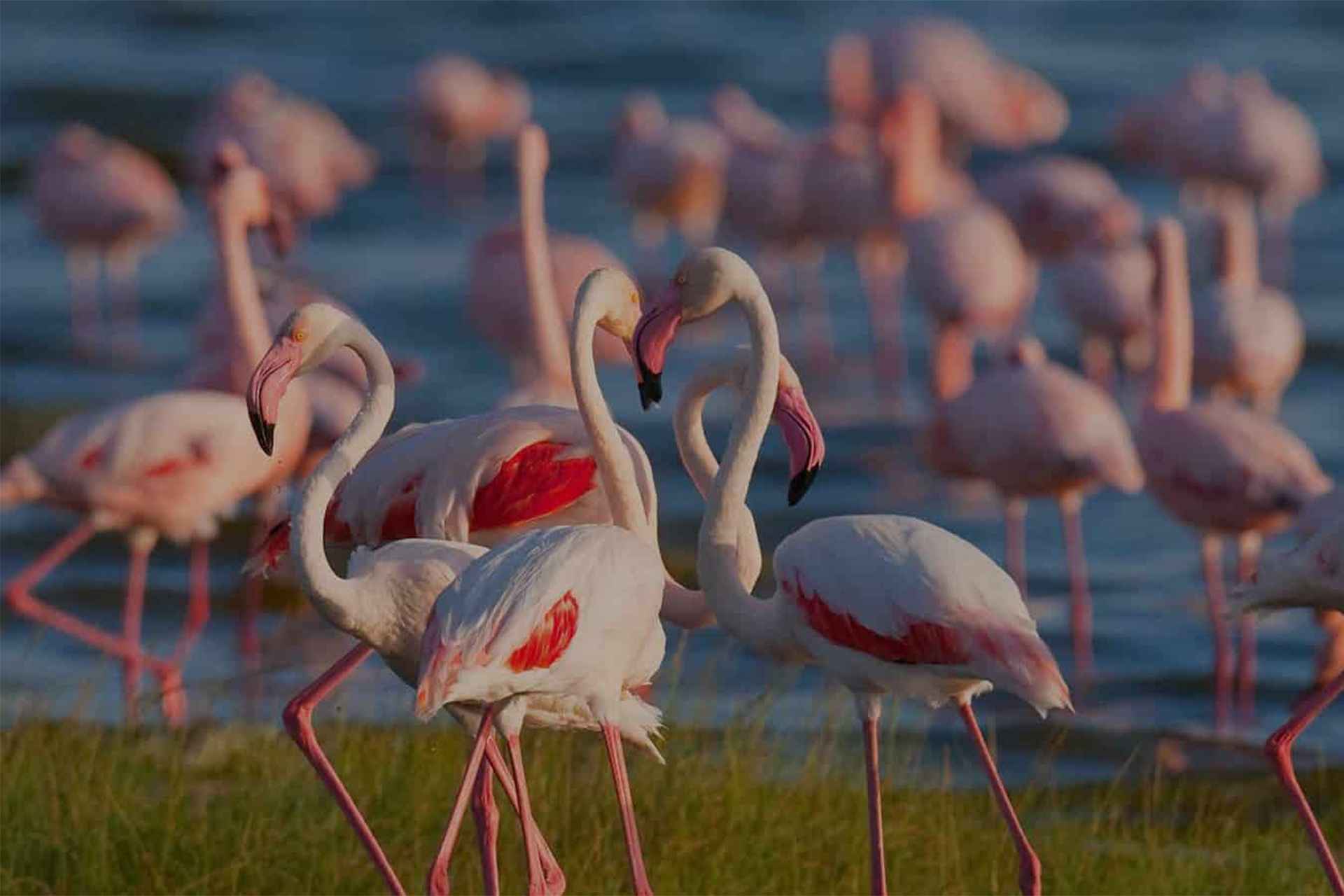
The crater floor holds a permanent resident population of lions, black rhinos, elephants, hippos, and flamingos, so no month is truly wasted here. The dry season from June through October brings clearer views and firmer rim roads, both of which matter for the steep descent into the crater. January and February, when the Ndutu Plains fill with calving wildebeest and concentrated predators, offer the highest wildlife density across the entire conservation area. Crowds peak from July through September, when lodges on the crater rim are fully booked well in advance.
Tarangire and Ruaha: Tanzania’s dry-season powerhouses
Both parks are at their absolute best from June through October. In Tarangire, famous elephant concentrations build around the Tarangire River as surrounding water sources dry out across the broader ecosystem. In Ruaha, the Great Ruaha River becomes a gathering point for staggering numbers of hippos, crocodiles, lions, and African wild dogs.
Both parks suffer significantly during the long rains. From March through May, road infrastructure in both parks deteriorates badly, and in extreme years bridges collapse and some sections close entirely. These are genuinely dry-season destinations, and planning a Ruaha or Tarangire safari during the long rains carries real logistical risk.
Peak season vs. green season: the real trade-off
Both seasons deliver a genuine safari experience. The question isn’t which one is “better” in the abstract, it’s which one fits your priorities, your budget, and your tolerance for uncertainty.
What peak season (June, October) actually costs you
Luxury lodge rates during peak season typically run 30, 50% higher than low-season pricing. Mid-range camps charge roughly $500, $1,000 per person per night, while luxury properties can reach $1,500, $2,550 or more. Many camps operate with minimum-night stays in July and August. The parks are busiest in August and September, with multiple vehicles occasionally converging on a single sighting in the northern Serengeti. For seasonal occupancy and timing data, see SafariBookings’ best-time guide. That said, the game-viewing clarity, the Great Migration access, and the near-guarantee of excellent predator sightings justify the premium for most travelers visiting Tanzania for the first time.
What you gain by going during the rains
Rates drop significantly during the green season, sometimes 40, 50% below peak pricing at camps that remain open. Single supplements are often waived as well. The long rains from March through May bring the lowest occupancy of the year, meaning you can sit at a waterhole without another vehicle in sight. The short rains from November through December hit a practical sweet spot: lower prices, mostly accessible roads, and the calving herds beginning to build in the southern Serengeti. For travelers who want the bush largely to themselves and can accept more variable wildlife conditions, November and December offer the best value on the Tanzania safari calendar.
Green season rewards for photographers and birders
For travelers who go specifically for images or avian diversity, the green season isn’t a consolation prize. In several specific ways, it’s genuinely superior to the dry season, and it’s worth understanding why before you automatically default to July.
Light, color, and drama: what the rains do to landscapes
The rains scrub the air clean. Backgrounds shift from dry brown to vivid green, and skies fill with dramatic cloud formations that the dry season simply doesn’t produce. Late-afternoon light during November through February delivers layered color that photographers working the dry season never see. Baby animals appear in abundance during the calving season, and predator action around vulnerable newborns is often more intense and sustained than a single river crossing.
Migratory birds and empty game drives
Between November and April, hundreds of Palearctic migratory species arrive from Europe and Asia, many in full breeding plumage. Species including European bee-eaters, white storks, steppe eagles, yellow wagtails, and willow warblers are reliably seen in both Tarangire and the Serengeti. Tarangire alone records over 550 bird species, and during the green season, birders often have the park to themselves. Guides have time to stop for 20 minutes on a single species without pressure from other vehicles. For dedicated birders, November through April is the most productive window Tanzania offers. See this guide to seasonal birding in Tanzania for recommended locations and timing.
Tanzania safari calendar: matching your window to the right itinerary
With the seasonal breakdown clear, the decision comes down to what you most want out of your trip. Here’s a direct framework for making that call:
- River crossings: July, October (peak Aug, Sep), northern Serengeti (Kogatende)
- Calving season and predator action: January, February, southern Serengeti and Ndutu
- Budget travel with solid game viewing: November, December (short rains)
- Birding and landscape photography: November, April
- Best overall multi-park game viewing: June, October
- Adding Zanzibar to your itinerary: June, October or January, February, avoiding the heavy April rains on the coast
For more sample itineraries and timing examples that pair parks efficiently, see our Our Travel Blogs.
Why local knowledge changes what’s possible
Generic timing advice gets you into the right month. What it doesn’t tell you is that the northern Serengeti migration can stall in one location for two weeks before moving, or that a specific waterhole in Tarangire is explosive in September but nearly empty by mid-October. The Kisambi Tours team operates year-round in Tanzania, which means real-time park conditions, direct relationships with lodge managers, and itineraries adjusted around what’s actually happening on the ground rather than what a fixed calendar suggests should be happening. That difference shows up on your game drives. If you’re new to safari travel, our article What Every First-Time Safari Goer Should Know Before Visiting Tanzania is a useful primer.
Plan around your priorities, not the calendar
The best time for a Tanzania safari is the month that fits what you want to see. Understanding the Tanzania dry season and rainy season trade-offs is what separates a good trip from a great one. The dry season from June through October delivers peak game viewing, reliable road access, and the Great Migration crossings. The short rains from November through December bring lower costs, extraordinary birding, and calving herds beginning to gather, while March through May offers the lowest crowds and prices, but with the most unpredictable road conditions and the fewest open camps.
Tanzania’s parks each follow their own rhythm. A well-sequenced itinerary, one that pairs the northern Serengeti with Ngorongoro and a Tarangire extension in the right order, can capture multiple highlights in a single 7, 10-day trip without backtracking or wasted driving time. The sequencing matters as much as the month.
If you’re ready to match your travel window to the right parks, camps, and daily game-drive schedule, the Kisambi Tours team is available to build your itinerary from scratch. Reach out directly for personalized planning with a local expert who knows which waterhole is worth the detour and which crossing site is active right now. No guesswork from a distance. Just honest planning from Tanzania. For additional timing details, see our Best Time For Safari In Tanzania guide.